This article highlights how to use finings to create a “bright beer’ using something cheap and readily available from your weekly shop: Gelatin.
Finings come in many forms, both traditional, animal derived products, and more recently, vegan-friendly products.
The basic premise is to add the fining to the beer.
Finings can be added to suit your packaging process.
Here I’ll show how I use gelatin as a fining for my beers. I add gelatin before packaging and force carbonating or bottle conditioning. It works.

Why Should I Add Finings To My Beer?
Simple: If you want to present pin-bright beer, use finings. No matter what, for everything but hazy styles, you need to drop out the yeast and any proteins in suspension in your final product (beer). Yes, a cold-crash will drop some yeast out. However, there’s nothing like the pin-bright beer you get from adding fining your beer.
Which Finings Should I use?
There are many products available on the market to fine your beer. Personally, I find Gelatin is cheap, easy to source, and simple to use. Ultimately, use what you like, but this product and process works very well.
Which Gelatin is Best to Use?
There are a variety of different gelatin products to buy, all provide a similar end product.
To fine the vast majority of my beer, I use a cheap supermarket product, namely: Dr. Oetker gelatin granular gelatin sachets. Following the below process results in consistent, a pin-bright final product. This does include a couple of additional steps to other products, but it’s a simple and cheap process to follow.
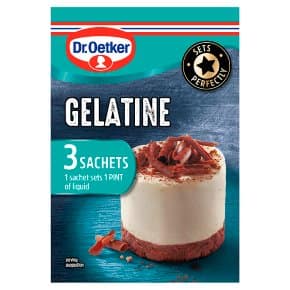
My Gelatin Fining Process:
- Run 100ml of freshly boiled water in a sterilised Pyrex glass jug.
- Cover with cling film and allow to cool for 5-10 minutes.
- Peel the cling film back:
- Add 5g (1tsp) of gelatin
- Mix well to dissolve the granules
- Re-cover with cling film and put in the microwave.
- Heat the water to 75C in 5-10 second pulses, taking the temperature at each stage.
- Stop when the temperature is 75C (Why Heat Gelatin to 75C.)
- This step is suited to bottling or keg, just choose the step for your process:
- Keg:
- Cold Crash the beer. Hold at 4C or lower for at least 24 hours before racking to keg.
- Open the sanitised keg and put the gelatin mix in the bottom of the keg before replacing the lid and purging the headspace of oxygen with Co2.
- Rack the cold-crashed beer to the keg through the beer-out post, avoiding splashing, eliminating oxidised beer. This mixes the beer through the fining for a fully homogenised mix.
- Force carb the beer under cold conditions.
- Bottle:
- Put the gelatin fining mixture in the fermenter before cold crashing.
- Cold crash the beer.
- Hold at 4C or lower for at least 24 hours before bottling.
- Bottle the beer using your usual process.
- I usually add a dissolved sugar solution to the fermenter.
- Keg:
Why Heat Gelatin to 75C?
Heating gelatin to 75°C (167°F) causes the protein structure to break down and melt. This ensures the gelatin is fully dissolved in the liquid. It also degrades the gelatin’s ability to form a strong gel (set) upon cooling.
When Can I Use Gelatin To Fine My Beer?
The above fining process is really simple and easy to use in the fermenter for bottle conditioning or kegging. You can also just use it in the keg
When to Add Finings For Bottle Conditioned Beer
For bottle conditioned beer:
- Add the fining to the fermenter before the cold crash for bottle conditioned beers.
- Bottle the beer using your usual bottling process.
When to Add Finings For Kegged Beers
For kegged beer:
- Cold crash the beer.
- Add the fining to the bottom of the keg, replace the lid and purge the keg.
- Rack the beer on to the finings at the point of packaging.
- Force-carbonate the beer at 4C to produce a clear beer after 24-36 hours.
- Expect the first pint to be a tad cloudy. Consider pouring a half and pouring it away.
Thanks great info . I wondered why you must heat to 75c ..
Also if you bottle and gelatin in the fermenter first . Does that not remove all the yeast so none left in suspension to aid the carbination in the bottle, and after say 2 weeks at room temp you have flat beer .
HI Paul, this is belt and braces information in my experience. Gelatin fining binds to yeast and other particles, helping them settle, so it does reduce yeast in beer, but there’s enough left to prime the beer. If you want clear beer, it’s a common process to fine the beer before cold crash, priming and bottling. Cheers.
I do think fining like this reduces dry hop flavour as we saw with Death of cowboy challenge where used gelatin. Personally I use Harris Starbrite 7ml to a keg is enough.